Does Your Website Need a Cookie Banner in India?
No law says "show a banner". Your trackers decide whether you need one.
4 minutes read

You've probably noticed cookie banners appearing on more Indian websites.
Some have a single "Accept" button.
Others offer:
Accept All | Reject All | Manage Preferences
So does every website in India now need one?
No Indian law simply says that every website must display a cookie banner.
That doesn't mean websites can ignore cookies and trackers.
Under India's Digital Personal Data Protection Act, 2023, the real question is whether your website processes digital personal data and, where it does, what lawful basis applies to that processing.
If your website relies on consent for some of that processing, the design of your cookie or privacy preference interface starts to matter a lot.
Start with what your website actually does
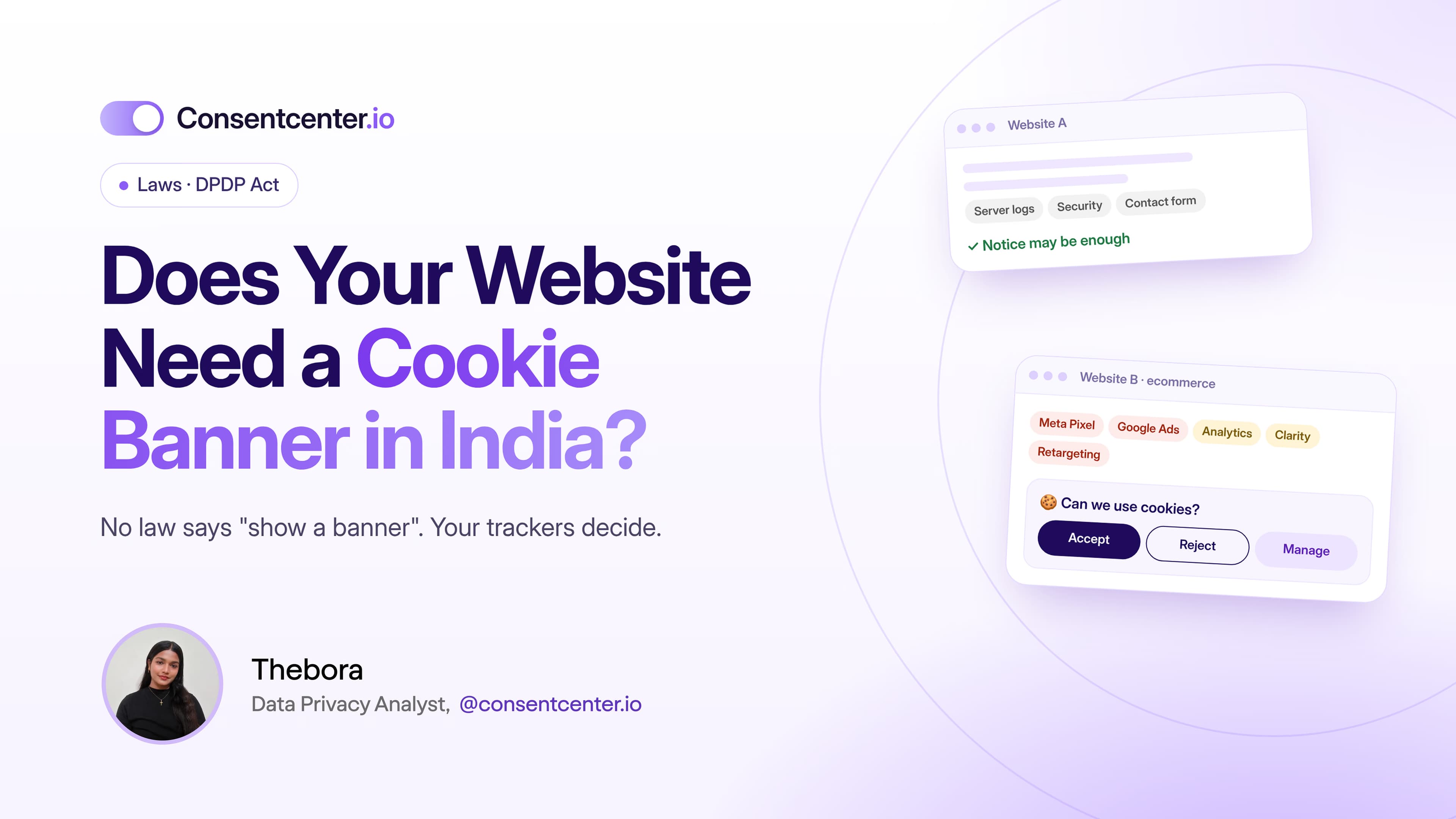
Consider two websites.
Website A
A small corporate website that uses:
- basic server logs
- security cookies
- a contact form
Website B
An ecommerce company that uses:
- Google Analytics
- Google Ads
- Meta Pixel
- Microsoft Clarity
- HubSpot
- personalised recommendations
- abandoned-cart tracking
- retargeting
Both are websites.
Their data processing is completely different.
Putting the exact same cookie banner on both sites would miss the point.
When should you consider a consent banner?
Take a careful look at your consent mechanism if your website uses technologies that process personal data for activities such as:
- behavioural analytics
- advertising attribution
- retargeting and audience building
- session recording and heatmaps
- cross-site or cross-device tracking
- personalisation based on browsing behaviour
- sharing visitor data with advertising partners
These activities usually go beyond what a visitor needs to use your website. Where they rely on consent, Section 6 of the DPDP Act expects that consent to be free, specific, informed, unconditional, unambiguous and given through a clear affirmative action.
A footer line saying "by using this site you accept cookies" is unlikely to meet that standard.
What about strictly necessary cookies?
Some cookies exist only to make your website work, for example:
- keeping a user logged in
- remembering a shopping cart
- load balancing
- fraud prevention and security
These may not need the same consent treatment as advertising or analytics trackers. But visitors should still be able to understand what your website does with their information, so describe them clearly in your privacy notice.
The test is simple: if you block it, does the page stop working? If the answer is "no, but we lose data", it probably isn't strictly necessary.
What a good banner looks like
If your assessment shows that consent is needed, the banner should do more than look compliant.
A well-designed consent experience:
- explains in plain language what data is collected and why
- describes purposes clearly, as Rule 3 of the DPDP Rules expects
- makes "Accept" and "Reject" equally easy to find and click
- starts with every non-essential category switched off
- keeps non-essential trackers blocked until the visitor chooses
- lets visitors come back and change or withdraw their choice at any time
- records what each visitor chose and when
Common banner mistakes
- A banner with only an "Accept" button
- "Reject" hidden behind two extra clicks
- Pre-ticked marketing or analytics categories
- Trackers firing before the banner even appears
- No way to reopen preferences after the first visit
- Copying another company's banner without checking your own trackers
That last one is the most common. Your banner should reflect your website, not someone else's.
How to assess your website
Before choosing a banner, work through six questions:
- 1What cookies and trackers are running on your website?
- 2What data does each one process?
- 3Why is that data being processed?
- 4Does the processing involve personal data?
- 5What basis under the DPDP Act applies?
- 6If consent is the basis, is it obtained before the processing starts?
Website A may end up with a short privacy notice and no consent banner at all.
Website B will almost certainly need a proper consent mechanism, with trackers held back until the visitor decides.
How ConsentCenter helps
ConsentCenter helps you answer those six questions and act on the answers:
- Cookie and tracker scanning finds every cookie, pixel and SDK on your website
- Purpose-based categories sort trackers so your banner matches what actually runs
- Real-time blocking keeps non-essential scripts off until visitors say yes
- Region-aware banners show the right experience for DPDP, GDPR and CCPA from one setup
- A preference center lets visitors change or withdraw consent at any time
- Consent records keep a timestamped log of every choice
Prepare before May 2027
The DPDP Rules were notified in November 2025. The main provisions on notice, consent and Data Fiduciary obligations are scheduled to take effect on 13 May 2027.
That gives you time to understand your website properly, instead of installing a banner in a hurry the week before.
Not sure what your website is running?
Your marketing team may have added more trackers than you realise. ConsentCenter can scan your website and show you exactly which cookies and trackers are active, and whether they fire before consent.
Get a Free Website Privacy Audit