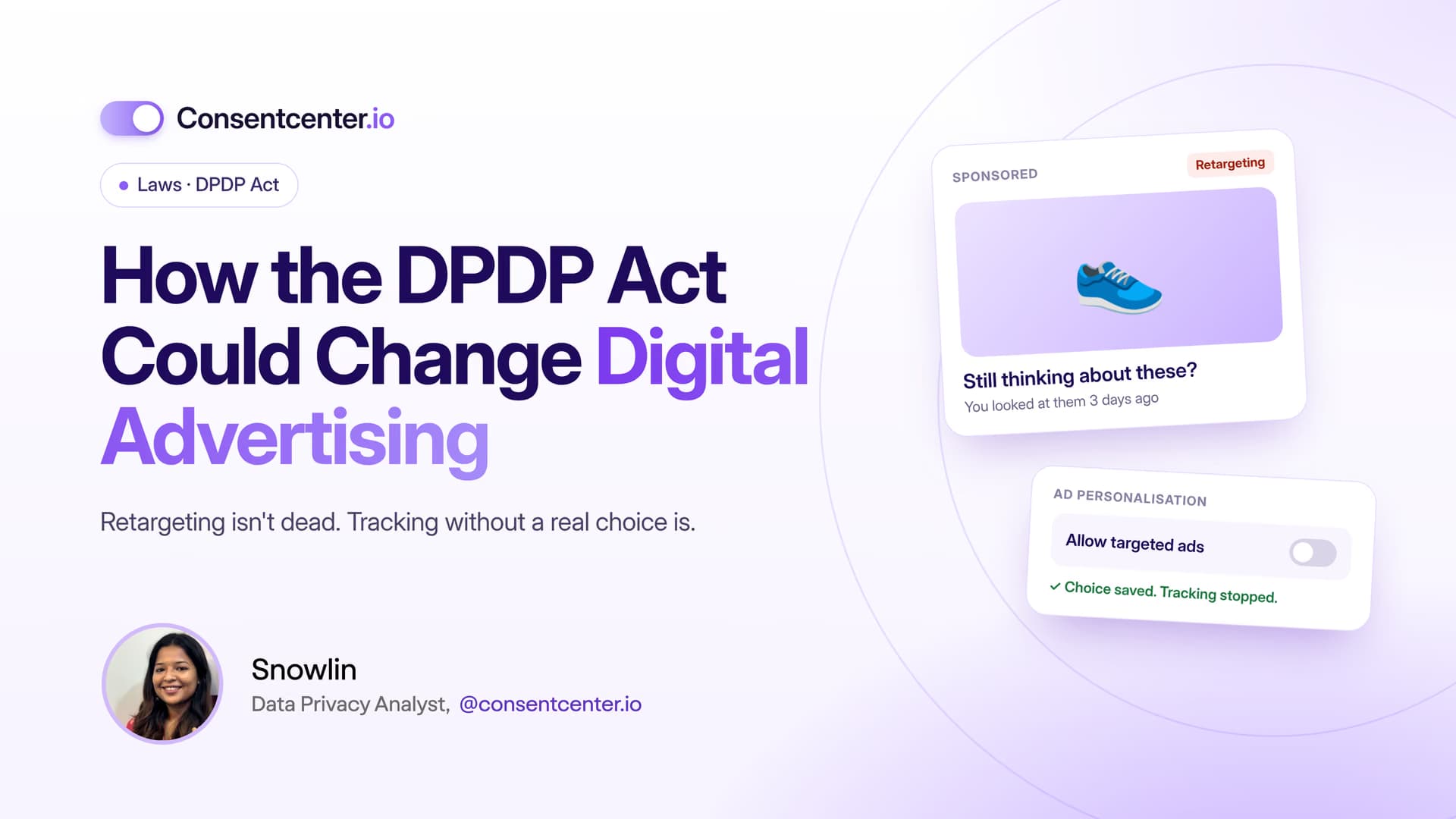
How the DPDP Act Could Change Digital Advertising
Retargeting, audiences and cookie banners all run on personal data. Here is what the DPDP Act and Rules mean for advertisers and publishers.
4 minutes read

Why is digital advertising changing?
Ever searched for a pair of shoes online and then seen ads for the same shoes everywhere you go? On social media, in another app, even on a random website. It can feel like the internet is reading your mind. It isn't. It's tracking.
Websites and apps collect information about the pages people visit and the things they click. Advertisers use those signals to decide which ads to show. For a long time, this was easy to ignore. Now, India's Digital Personal Data Protection (DPDP) Act, 2023, and the DPDP Rules, 2025, put the focus on how personal data is used and on giving people a real choice.
What does the DPDP framework mean for advertising?
The Act uses the term Data Fiduciary for any organisation that decides why and how personal data is processed. Depending on their role, brands, publishers, app owners, and ad platforms can all have duties under the law.
Here are the main points:
- Clear notice: Tell people what personal data you collect and why, in words they can understand.
- Meaningful consent: Where consent is the legal basis, people must make a clear choice. Silence cannot be treated as a yes.
- Easy withdrawal: Taking back consent should be simple.
- Purpose limitation: Data collected for one purpose should not quietly be used for something else.
- Children's data: The law has special protections, including parental consent and limits on certain tracking and targeted ads, subject to exemptions.
What may change for advertisers and publishers?
- Audience targeting: Check whether the data behind your audiences was collected and used the right way.
- Cookie banners: Avoid designs that push people to accept everything. Give users a clear way to understand and manage their choices.
- Advertising partners: Know which vendors receive personal data and what they do with it.
- Retargeting: Keep proper records of consent where it is needed, and respect what users choose.
- Measurement: Ask whether you can get the same reports with less personal data.
Retargeting is not illegal by default. But it becomes a problem if people were never properly told, or if the legal basis was missing.
What should businesses do now?
A privacy policy is only one piece. What matters is what your website and apps actually do.
- Audit trackers: Find all cookies, pixels, software development kits (SDKs), and ad tags.
- Map data sharing: Note which third parties get personal data, and why.
- Review the consent experience: Make choices clear and avoid misleading design.
- Keep records: Save consent and any changes people make to their preferences.
- Respect choices: Make sure tracking stops when a user says no or withdraws consent.
- Protect children: Check your services and ads against the rules for children's data.
- Check vendor agreements: Spell out who is responsible for what.
The Act and Rules come into force in phases. Find out which rules apply to you and when, and plan ahead instead of rushing at the last minute.
Where does ConsentCenter fit in?
The checklist above is easy to write and hard to do by hand. Consent data usually sits in many places: the website, the mobile app, the CRM, the ad platform, the analytics tool. Keeping all of that in sync is a big job.
That is the problem ConsentCenter is built to solve. It is a Universal Consent and Preference Management platform. In simple words, it gives you one place to collect consent, store it safely, pass it on to your other tools, and make sure those tools follow it.
How it works
ConsentCenter follows five steps, from the moment someone gives consent to the moment it is enforced:
- 1Collect: Capture consent from websites, mobile apps, and other touchpoints using SDKs and ready-made connectors.
- 2Process: Check and sort the consent data against the rules that apply.
- 3Store: Keep it in a consent ledger with version history, time-stamped records, and proof of consent, so you have an audit trail when you need one.
- 4Sync: Pass the consent status to your other systems, such as CRMs, customer data platforms, ad platforms, and analytics tools.
- 5Enforce: Block actions that don't match what the user agreed to.
Made for DPDP, and for other laws too
ConsentCenter supports India's DPDP Act, including consent-based processing, Data Fiduciary duties, cross-border rules, and grievance redressal. It also covers other privacy laws such as GDPR, CCPA/CPRA, PDPL, PDPA, and APPI. That is handy if your ads reach people in more than one country, because you can manage everything in one place instead of running a separate setup for each law.
Privacy and effective advertising can work together
Good advertising does not need every little detail about a person. It needs you to be clear about what you collect, careful about how you use it, and respectful when people make a choice.
If you want to see how ConsentCenter can fit your website, your ad setup, or your DPDP plan, you can book a demo or write to hello@consentcenter.io.
Explore ConsentCenter
One place to collect consent, store it safely, pass it on to your other tools, and make sure those tools follow it.
Explore ConsentCenter